 “`html
Paternity in Arizona: Legal Implications and Procedures
Establishing paternity is a critical legal process that carries significant implications for the rights and responsibilities of fathers, mothers, and children. In Arizona, this process not only acknowledges the father-child relationship but also influences custody, visitation, and child support matters. As an essential step in safeguarding children’s rights and welfare, understanding how paternity is established and contested is imperative for affected individuals.
Why Establish Paternity in Arizona Family Court Cases?
The establishment of paternity is fundamental to several aspects of family law in Arizona. Legal recognition of the father-child relationship is crucial for determining vital issues such as custody, parenting time, and visitation rights. Importantly, it ensures a child’s access to financial support and entitlements, such as health insurance and inheritance rights. Moreover, a firm establishment of paternity allows the child to access their father’s medical history, which is valuable for healthcare considerations and identifying potential genetic health issues.
Ways to Establish Paternity in Arizona
Voluntary Acknowledgment of Paternity in Arizona
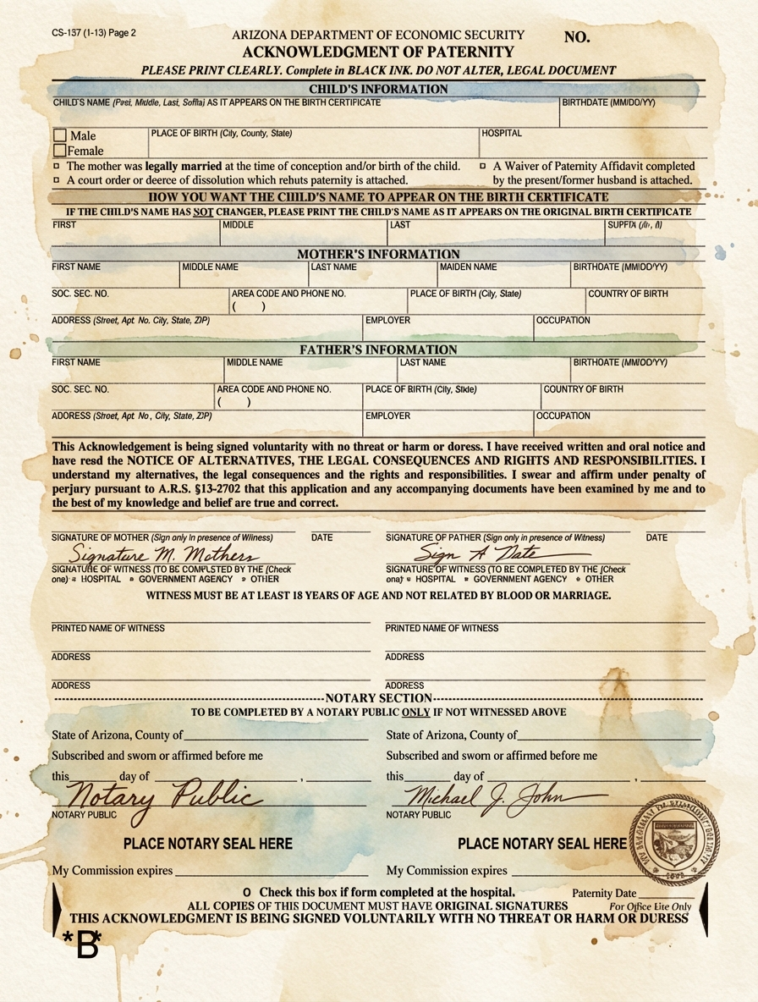
One of the most straightforward methods for establishing paternity in Arizona is through voluntary acknowledgment. This involves both parents signing a legal document that acknowledges the man as the child’s father. The document is then filed with the Arizona Department of Economic Security. This process is typically done at the hospital at the time of birth, simplifying legal procedures for unmarried parents.
Court-Ordered Paternity Testing Procedures in Arizona
When voluntary acknowledgment isn’t possible, paternity can be established via court order. This involves initiating a paternity petition in Arizona family courts, which may lead to court-ordered genetic testing. The process demands DNA tests, typically via a buccal swab, to determine biological parentage definitively. Courts rely on such scientific evidence to make determinations about custody, child support, and visitation arrangements, ensuring the child’s best interests are served.
Rights to File a Petition for Paternity
According to Arizona law, several parties can initiate a paternity petition. These include the mother, the alleged father, the child through a legal representative, and the state, especially when public assistance is involved. The involvement of different parties highlights the shared responsibility regarding paternity establishment and underscores the state’s interest in securing child welfare.
Presumption of Paternity in Arizona
Under Arizona statute A.R.S. § 25-814, certain conditions establish a presumption of paternity. This includes situations where a man is married to the child’s mother at the time of birth. Moreover, if a child is born within ten months of the end of a marriage or the man has signed the child’s birth certificate, he is presumed to be the father. While these presumptions simplify the process of establishing legal responsibilities, they can be contested in court with appropriate evidence.
Parental Rights Without Paternity Establishment
While it is theoretically possible for a man to claim parental rights without formal paternity, Arizona laws generally require legal establishment of paternity to secure such rights. Without established paternity, an alleged father cannot make legal or medical decisions for the child, nor can he claim custody or visitation rights. Additionally, the absence of formally acknowledged paternity may restrict the child’s access to financial support and benefits from the father.
Correcting Errors on Birth Certificates
In cases where the wrong person has been listed as the father on a birth certificate, Arizona law, under A.R.S. § 36-334, provides avenues to rectify this. Establishing correct paternity through genetic testing is the first step towards amending the document. Once accurate parentage is confirmed, the court can order alterations to the birth certificate, ensuring that all legal responsibilities and rights are correctly allocated.
Correct identification and documentation of a child’s paternity is an essential component of familial legal processes, offering protection and clarity for all parties involved.
Conclusion
Proving paternity in Arizona is a fundamental legal process that impacts not only the father and mother but significantly affects the child’s life. Precise determination of paternity ensures access to necessary financial support, benefits, and a correct understanding of familial lineage. If you require guidance with paternity issues, consulting experts in law, such as Lucas Law, can provide personalized legal direction tailored to your particular circumstances.
“`
Originally Post From https://lucaslawaz.com/establish-paternity-arizona/
Read more about this topic at
Establish Paternity – Arizona Department of Economic Security
How to Establish Paternity, Legal Decision-Making, …