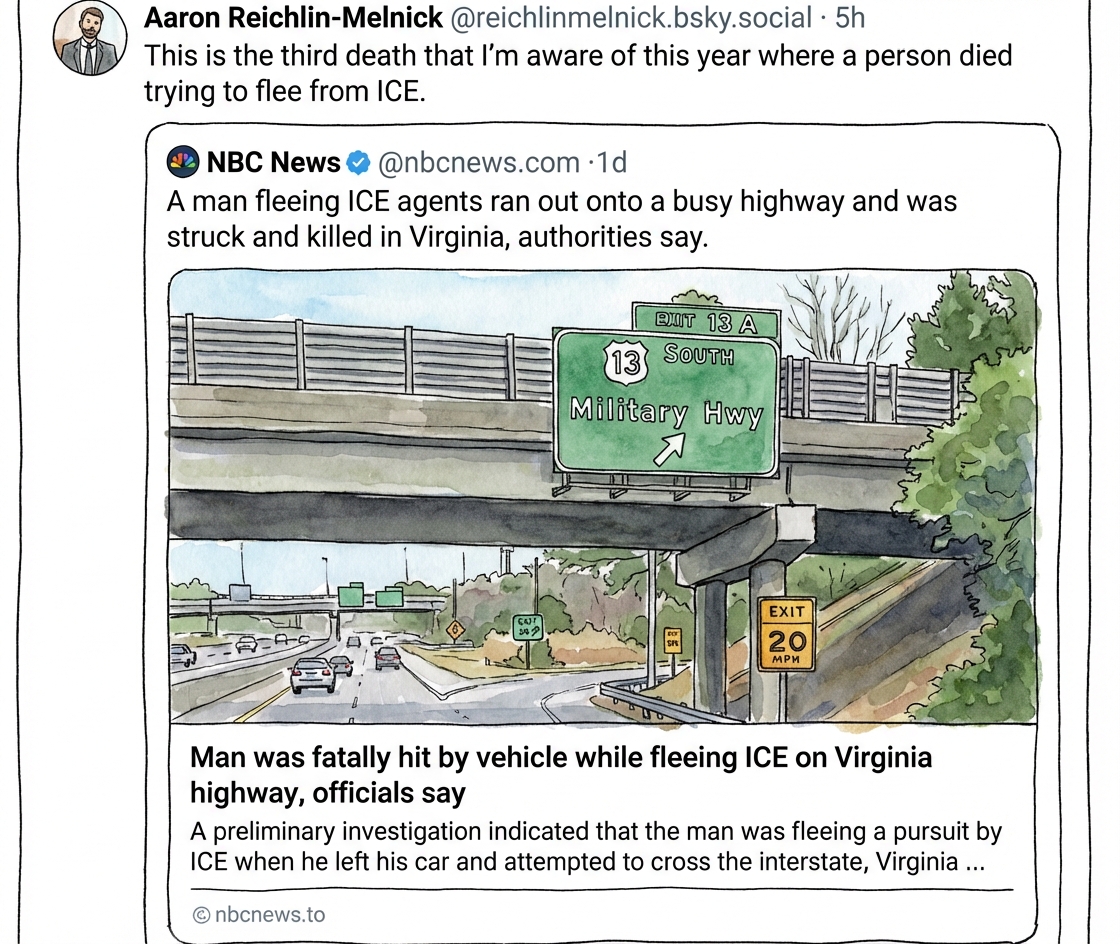
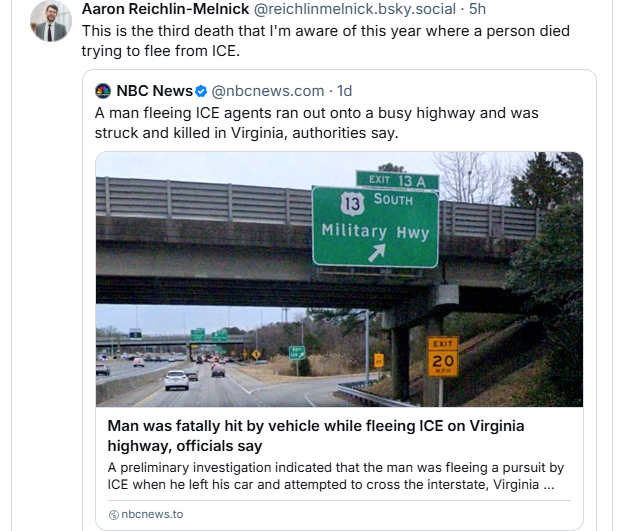
Incident Analysis: A Tragic Collision on a Busy Virginia Highway
On a seemingly ordinary Thursday morning on I-264 eastbound in Virginia, a series of events unfolded that has since raised significant questions about the tactics employed in targeted immigration enforcement. The disturbing incident, in which Jose Castro-Rivera—a 24-year-old Honduran national—was fatally struck by a pickup truck, invites us to take a closer look at the various tangled issues surrounding public safety, law enforcement protocols, and immigration policy.
The chain of events started when Immigration and Customs Enforcement (ICE) stopped a vehicle as part of a targeted, intelligence-driven operation. Reports indicate that officials determined the occupants of the vehicle were in the United States illegally. Amid the tension, Castro-Rivera resisted detention, fled the scene, and ended up attempting to cross a busy highway. His desperate escape, tragically, culminated in an accident that ended his life. This editorial examines the many twists and turns of an operation that, though intended to uphold federal law, ended with a public safety crisis and unforeseen consequences.
Understanding Immigration Enforcement Tactics on U.S. Highways
At the heart of this event lies an issue that is both complex and filled with difficult choices: the role of ICE in executing targeted enforcement operations. Federal agencies have, in recent weeks, carried out several high-profile crackdowns. While such operations are meant to identify and detain individuals who are in the country illegally, these encounters on public thoroughfares highlight a number of confusing bits and tricky parts that require careful examination.
ICE’s operations are based on intelligence and targeted strategies. A spokesperson confirmed that the vehicle in question was stopped due to a calculated operation focused on specific criminal activity and immigration matters. However, the subsequent pursuit that led to a chaotic highway scene reveals a number of delicate details that many law enforcement and legal analysts might describe as having hidden complexities.
Risks of High-Speed Pursuits in Urban Settings
One of the major concerns after this tragic incident is the physical risk posed to the public. Highways are designed for the smooth and predictable flow of traffic. When any interaction—particularly one involving ICE—occurs on such roads, it inadvertently places both the targeted individuals and uninvolved motorists at significant risk.
- Safety Hazards: High-speed vehicle pursuits and sudden pedestrian escapes, as seen in this case, create conditions that are nerve-racking for other road users who simply want to get from point A to B safely.
- Operational Risks: Officers involved in such operations face off-putting challenges when trying to balance the execution of law enforcement protocols with the dynamic and unpredictable environment of busy highways.
- Public Reaction: When incidents like this occur, communities become worried about the overall methods of enforcement employed in their neighborhoods, calling for a review of tactics that might compromise public well-being.
It is important to note that the approach taken in stopping and detaining individuals must factor in both the risk to personal safety as well as to the public. The unfortunate outcome in this case shows that even well-intentioned operations can turn catastrophic without the proper contingency plans in place.
Public Safety and Community Impact
The fatal accident has ignited a debate on whether the tactics used in targeted immigration enforcement adequately consider public safety. The convergence of a pursuit on a busy interstate, the sudden appearance of a fleeing individual, and a distracted driver unleashing a chain reaction is a scenario laden with responsibility questions for federal agencies.
This event has made many ask: How do law enforcement and immigration officials weigh the urgency of detaining individuals against the risk of escalating a situation? The community’s trust in immigration operations is jeopardized when these encounters turn into tragedies. In addition to the obvious loss of life, the community must also contend with the psychological ramifications of witnessing or learning about such chaotic scenes.
Community Concerns Over ICE Operations
At the local level, residents often express mixed feelings regarding ICE engagements in their neighborhoods. A few of those concerns include:
- General Confusion: Many community members are left puzzled over why a highway, designated for safe travel, suddenly becomes a battleground for immigration enforcement.
- Safety of Bystanders: The fear that any enforcement operation could quickly spiral out of control is very real, especially when roads are congested and conditions can turn overwhelming in seconds.
- Trust in Law Enforcement: Incidents like this lead to discussions about whether current policies strike the right balance between adhering to immigration laws and fostering community safety.
These concerns suggest that the public is in urgent need of a clear and balanced policy that takes the nerve-racking potential of such operations into account. It is not simply a matter of enforcing the law, but doing so in a way that minimizes risks to everyone involved.
ICE’s Tactics: Balancing Enforcement with Public Welfare
ICE operations rely heavily on intelligence-driven strategies to decide when and how to intervene. However, the details of these operations, including how to manage any ensuing chaos, often involve fast-paced decisions made under intimidating circumstances. The manner in which these agencies carry out their work dictates not only the success of the operation but directly impacts community safety.
When incidents like that on I-264 occur, we are prompted to ask whether the particular methods used are sufficiently refined to handle the understated complexities of real-life scenarios. Should ICE have taken more measures to ensure that the ongoing operation did not transition into a high-speed highway chase where the life of an individual might hang in the balance?
Understanding Targeted, Intelligence-Based Operations
Targeted operations are designed to be a surgical, intelligence-based approach, rather than a blunt instrument. In theory, these actions permit ICE to focus solely on individuals suspected of criminal behavior or those present illegally in the country. The intended benefits include not only the effective enforcement of immigration laws but also the prevention of broader criminal activity.
Yet, as this incident demonstrates, the seemingly well-planned operation took a turn that had dire consequences. The following elements are critical in any such operation:
- Pre-Operation Planning: Detailed risk assessments and contingency plans are essential to address potential escape attempts or sudden movements that might disrupt public safety.
- On-Scene Flexibility: Officers must be empowered and trained to adjust strategies on the go. The ability to figure a path through unforeseen events is super important in maintaining public order.
- Community Safety Considerations: The ultimate responsibility for protecting civilians should guide every tactical decision, ensuring that the enforcement mission does not inadvertently transform a situation into a full-blown safety hazard.
These subtle details underscore that while intelligence-driven operations are key to immigration enforcement, the little twists on the ground can have dramatic outcomes if not managed with holistic planning that factors in every possible hazard.
Legal Implications and Accountability in ICE Operations
The fatal highway incident not only raises public safety concerns but also pushes us to examine the legal and ethical responsibilities of federal agencies in the conduct of such operations. Government agencies, such as ICE, carry a super important burden when they go out on operations that could expose the public to risks.
Legal frameworks governing ICE operations are designed to offer oversight while enabling effective law enforcement. However, every incident that ends tragically forces us to reflect on whether these laws adequately account for the messiness of real-world situations. The following points should be carefully considered by lawmakers and legal experts:
- Operational Protocols: Are current procedures and protocols refined enough to direct officers in managing rapidly evolving situations? The sudden turns taken during this enforcement operation suggest that there could be gaps in how officers are trained to intervene in fluid scenarios.
- Accountability Mechanisms: In the aftermath of an incident, clear and transparent investigations are demanded by both the public and affected communities. This ensures that agencies are held to their operational standards and that any oversights are addressed.
- Legal Oversight: The balancing act between rigorous immigration enforcement and ensuring public safety necessitates robust oversight mechanisms. Ensuring that operations are both legally sound and empathetically executed is a delicate process that requires input from multiple branches of government.
For legal scholars and policymakers, there is a need to scrutinize these operations, focusing on the little details that can easily turn a targeted enforcement maneuver into a public hazard. The incident serves as a stark reminder that the law must be interpreted in ways that do not compromise the safety of any group—be it the targeted individuals or the unsuspecting public.
Repercussions for Public Trust in Immigration Enforcement
Incidents like the tragic highway accident have long-lasting consequences on how the public perceives law enforcement and immigration agencies. Trust, once broken, is hard to rebuild, and the complexity of immigration enforcement makes it critical to maintain public assurance through transparency and accountability.
Every encounter that turns violent or results in a loss of life fosters a climate that is full of problems for community relations. Even if an operation is executed with full adherence to legal guidelines, unexpected outcomes such as these can cast doubt on the overall approach to immigration enforcement. It is therefore crucial for agencies to:
- Engage with Community Leaders: Ongoing dialogue with the communities most affected can help bridge the gap between federal operations and public trust.
- Provide Clear Communication: Transparency regarding the rationale behind targeted operations and the steps taken to protect both officers and civilians is key.
- Implement Feedback Mechanisms: Learning from every incident allows officials to iterate on tactics and policies alike, ensuring that future operations are less risky and more community-oriented.
This incident could serve as a catalyst for such measures, pushing federal agencies to reexamine traditional enforcement protocols while considering strategies that better protect public welfare. The need to restore and maintain trust in the system is super important, particularly in areas where law enforcement activities are keenly felt and scrutinized.
Assessing ICE’s Methods Through a Public Safety Lens
When an operation designed to target illegal immigration inadvertently compromises road safety, it is a clear signal that the current methods contain several tricky parts. ICE’s intention of employing intelligence-driven tactics to identify and apprehend individuals does not in itself guarantee that the mission will unfold without unintended consequences. The highway incident offers several lessons in this respect:
- Anticipating Sudden Escalations: It is critical that operations are designed to cope with sudden changes, such as a suspect fleeing in an unpredictable manner.
- Public Awareness and Preparedness: Ensuring that the general public is not caught in the crossfire of law enforcement maneuvers should be central to any such operation.
- Interagency Coordination: The incident underscores the need for stronger coordination between agencies. While ICE was in charge of the targeted operation, the local law enforcement teams, such as the Virginia State Police, ultimately had to manage the chaotic aftermath.
In many ways, the event is a textbook example of what can go wrong when multiple agencies must suddenly figure a path through a situation that escalates beyond its initial scope. These fine points highlight the importance of developing more robust cross-agency strategies that are designed to protect everyone—regardless of their status or location.
Considering the Broader Context: Fleeing Pursuits and Highway Safety
The behavior exhibited by Castro-Rivera in attempting to flee from an ICE operation raises questions about the legal and practical implications of such pursuits. When individuals are placed in an overwhelming, off-putting situation, their instincts can drive them to take drastic measures that have far-reaching implications for both themselves and other road users.
Highways are not only conduits for vehicles; they are shared spaces where the safety of bystanders is of utmost concern. The incident forces us to confront several critical issues:
- Understanding Flight Responses: The decision to run or flee from law enforcement can be seen as a natural, albeit dangerous, reaction in moments of perceived threat. This behavior, while not justifiable, highlights the intense pressure some individuals experience during confrontations with authorities.
- Policy Reconsiderations: How should law enforcement agencies handle such situations? Are there alternative methods that would reduce the likelihood of a person taking such desperate action?
- Risk Mitigation Strategies: Future operations might benefit from integrating de-escalation strategies that consider the potential for sudden, panic-driven responses.
Delving into these issues is key to understanding why incidents like this one are more than isolated events; they are reflective of broader trends in law enforcement tactics, community safety, and immigration policy. Moving forward, agencies could benefit from incorporating more flexible protocols that anticipate the unexpected and safeguard public roads from becoming dangerous chase scenes.
Strategies for Integrating Law Enforcement and Community Safety
Given the outcomes of this tragic episode, it is essential that both policymakers and enforcement agencies reexamine their strategies from the viewpoint of everyday safety. An effective and balanced approach should not only focus on implementing immigration laws but must also prioritize the protection of every innocent bystander.
The following strategies might help in charting a safer path through the confusing bits of immigration enforcement:
| Strategy | Key Considerations |
|---|---|
| Enhanced Pre-Operation Planning | Conduct comprehensive risk assessments to identify potential hazards on busy roads; introduce contingency measures in case of sudden escalations. |
| Improved On-Scene Coordination | Facilitate smoother communication and unified command structures between federal ICE agents and local law enforcement to ensure real-time situational awareness. |
| Community Engagement Initiatives | Develop programs that foster dialogue between law enforcement and community members, emphasizing transparency and shared safety interests. |
| Advanced Training Programs | Invest in training that focuses on de-escalation tactics, managing overwhelming situations, and safely handling pursuits in active traffic conditions. |
Incorporating these strategies would not only address the safe execution of targeted operations but also help mitigate similar problems in the future. As agencies strive to adapt to the fast-evolving challenges of immigration enforcement, prioritizing community safety alongside law enforcement objectives is a must-have element of contemporary policy-making.
Learning from the Past: The Need for Ongoing Reforms
The fatal incident on I-264 should serve as a driving force for serious reflection and reform. It is a stark reminder that every enforcement action, no matter how targeted or intelligence-driven, carries risks that can quickly escalate into public safety disasters. In light of this, officials and lawmakers must consider a series of reforms aimed at addressing the problems head-on.
Key areas for potential reform include:
- Reviewing Engagement Protocols: An independent review of ICE’s operational protocols may reveal areas where enhancements are needed, especially in scenarios where the potential for panicked responses is high.
- Implementing Technology-Driven Solutions: Incorporating modern technological solutions—such as real-time flight risk analytics and improved communication systems—could help officers better anticipate and manage dynamic situations on the ground.
- Legislative Oversight: Greater legislative scrutiny of immigration enforcement methods could ensure that tactics are updated regularly to reflect the ever-changing landscape of legal and societal expectations.
- Enhanced Training and Simulation Programs: By simulating high-risk encounters in controlled environments, agencies can work through the fine points of their operational strategies and allow officers to practice making safe decisions under pressure.
The goal of these reforms should be to ensure that every enforcement action is meticulously planned and executed in a way that minimizes risk—not only to the individuals directly involved, but also to the broader public. Such steps are critical in fostering an environment where community trust and the rule of law reinforce each other, rather than exist in conflict.
International Perspectives on Immigration Enforcement
While the incident on I-264 is rooted in U.S. domestic policy, it is also indicative of global challenges related to migration and law enforcement. Many countries face similar quandaries when attempting to balance the enforcement of immigration laws with the duty to protect public safety. A comparative analysis might bring several subtle details to light:
- Different Enforcement Models: In some nations, immigration checks are primarily conducted at designated border control points rather than deep within communities or on busy highways. This approach tends to limit the risk of sudden public hazards.
- Community-Centric Approaches: Other countries have embraced community outreach initiatives that focus on building relationships between law enforcement and immigrant communities, thereby reducing the likelihood of confrontations escalating into dangerous situations.
- Legal and Administrative Flexibility: International models often incorporate elements of flexible law enforcement training that emphasize the importance of adapting to unexpected circumstances. Such practices might offer useful insights into refining tactics so that operations do not inadvertently endanger the public.
Examining these international perspectives gives us a broader understanding of the challenges faced by U.S. agencies. While the legal frameworks and societal expectations vary from one country to another, the core principle remains universal: enforcement must be conducted in a way that does not sacrifice the safety of citizens and residents in the process.
Reflections on Policy: Balancing Immigration Law and Public Welfare
As the aftermath of this tragic incident continues to be dissected by legal experts, community leaders, and policymakers alike, one thing becomes clear: balancing strict immigration law enforcement with the safety of the public presents a series of intimidating, complicated pieces that require both heart and savvy practical insight.
Policymakers must tackle several key questions to ensure that future operations are not only legally sound but also aligned with broader public interests:
- Where should the line be drawn? How do we determine the point at which aggressive enforcement tactics become counterproductive, leading not just to the apprehension of illegal immigrants, but to unintended harm to individuals and the public?
- What is the role of accountability? Ensuring that agencies remain transparent about their operations is crucial to maintaining trust and refining tactics in light of past mistakes.
- How can community safety be better integrated? Moving forward, enforcement agencies need to embed safety and de-escalation measures into their training curricula. This may include simulations and scenario-based learning that highlight the small distinctions which, in the heat of the moment, can make a significant difference.
Finding a path through these tangled issues is undoubtedly challenging. However, the systemic analysis of past events helps pave the way toward a more balanced approach—one that respects the law while ensuring that every enforcement operation minimizes risk and preserves the lives and well-being of all involved.
Concluding Thoughts: A Call for a Safer Future
The death of Jose Castro-Rivera on a busy Virginia highway is a tragic reminder that no operation, however targeted, is ever without risk. It is clear from the unfolding of events that the current framework of targeted immigration enforcement demands not only introspection but also meaningful reform. This incident is emblematic of the many complicated pieces inherent in balancing federal immigration objectives with the practical need to protect public safety.
Through a balanced lens, it becomes evident that:
- Law enforcement agencies must continuously work through their processes, ensuring that every engagement is carried out with an eye toward the unforeseen twists and turns of human behavior.
- Community safety and trust should remain at the forefront of any immigration policy—when citizens feel secure, enforcement operations are far more effective and less charged with tension.
- The legal frameworks and operational protocols guiding these actions must be regularly reviewed, updated, and scrutinized to identify where improvements can be made.
As we reflect on this unfortunate event, we are called to consider both the high stakes involved in enforcing immigration laws and the equally high cost of public safety. While the pursuit of immigration control is a key objective for many agencies, it must never come at the expense of human life or community well-being.
Ultimately, the need for change cannot be overstated. The response to this incident should serve as a catalyst for reform—one where tactical decisions are guided by the essential responsibility to protect the public, where every officer is equipped to figure a path safely through even the most overwhelming of emergencies, and where future operations are designed with both enforcement effectiveness and community safety as non-negotiable priorities.
Looking Ahead: Building a Framework for Safer Enforcement
The tragic outcome on I-264 is an opportunity for all stakeholders—law enforcement agencies, policymakers, and community leaders alike—to engage in a candid conversation about the future of immigration enforcement in America. As we navigate the delicate balance between upholding the law and ensuring public welfare, several initiatives can guide us toward a safer and more effective system:
- Enhanced Training Programs: Implement ongoing training modules that simulate high-risk scenarios, enabling officers to get into real-life situations where they must react to sudden changes without compromising public safety.
- Stronger Cross-Agency Collaboration: Develop integrated communication channels between federal, state, and local agencies to ensure rapid coordination during operations. This approach can help manage nerve-racking encounters in real time, minimizing chaos on busy roadways.
- Policy Reforms and Legislative Oversight: Encourage lawmakers to revisit and update existing enforcement guidelines, incorporating lessons learned from recent incidents to form a more flexible yet controlled framework for ICE operations.
- Community Outreach: Foster more robust dialogue between immigration authorities and local communities. By taking a closer look at community needs and concerns, agencies can adapt their strategies to reduce misunderstandings and build mutual trust.
These steps represent not just remedial measures, but also a vision for a future where immigration enforcement and community safety operate hand in hand. It is a future where every decision is weighed with consideration for the human cost of enforcement, and where the operational parameters are adjusted to prevent tragedies like the one witnessed on I-264.
Final Reflections: The Path Forward
In conclusion, the fatal incident involving Jose Castro-Rivera transcends the immediate tragedy of a life lost on a busy highway—it serves as a potent symbol of the many challenging parts of attempting to enforce immigration laws in unpredictable environments. As discussions continue and reforms are considered, it remains clear that a balance must be struck between executing intelligence-based operations and ensuring the safety of the public.
Law enforcement agencies and policymakers must both figure a path through these complicated pieces, analyzing every fine point of their operational protocols while remaining open to change. Only through transparent dialogue, ongoing training, and carefully considered legislative reforms can we hope to prevent similar tragedies in the future.
While the road ahead is filled with twists and turns and may seem as overwhelming as it is intimidating, the commitment to protecting public safety and upholding the law must remain a super important guiding principle. By addressing the hidden complexities and taking courageous steps toward reform, we can work to forge a system that is more secure, more understanding, and ultimately, more just for everyone.
In Summation
This tragic event is a call to action—a reminder that the enforcement of immigration laws need not come at the cost of innocent lives and community trust. As we digest the lessons learned from this unfortunate episode, we must all work together to ensure that the future of immigration enforcement is reimagined in a way that places equal importance on effective law enforcement strategies and the safety, dignity, and well-being of every person impacted by these operations.
The challenges are many, the issues are tangled, and the stakes are undeniably high. But in facing these head-on, with compassion, clarity, and a willingness to change, we can strive toward a safer and more balanced path forward.
Originally Post From https://wtop.com/virginia/2025/10/honduran-man-killed-on-virginia-highway-while-fleeing-ice-agents/
Read more about this topic at
Honduran immigrant dies while fleeing ICE, bringing raids …
Man killed while fleeing ICE on I-264 identified as …
